Trump Administration To Fast-Track Comprehensive Review Of Childhood Vaccine Schedule
Updated


President Donald Trump praised the ACIP panel for removing universal hepatitis B vaccine recommendations for all children on the day of birth and called for a fast-track, comprehensive review of the vaccine schedules of other countries around the world to “better align the U.S. vaccine schedule so it is finally rooted in science and common sense.” Journalist Emily Kopp received a draft of the memo and reported for the Daily Caller that the comprehensive review will look to compare the US childhood vaccination program to other nations that have better health outcomes with fewer vaccines.
A chart indicates the US childhood vaccination schedule recommends 72 vaccine doses for 18 diseases, including annual shots for influenza and COVID-19. The administration has already shifted COVID-19 vaccination from a universal recommendation to individual-based decision-making. The chart also compares Denmark, Japan, Germany, and the United Kingdom. An X account called The Real Truther said the countries were cherry-picked and didn’t include Israel and Australia, which have similar vaccine schedules and are two of the healthiest countries in the world.
Below is a chart with vaccine schedule data alongside infant mortality rates from UNICEF data and life expectancy rates according to the CIA, including Israel and Australia. The data is sorted from the lowest infant mortality (under 5) rate to the highest.
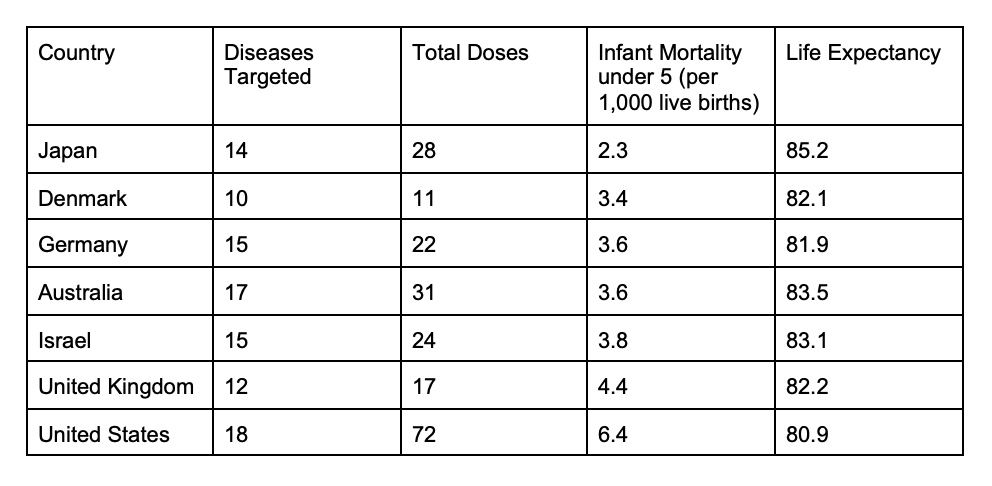
The United States recommends more than twice the number of vaccine doses compared to all other countries in the comparison. The US also has the highest rate of infant mortality and the lowest life expectancy compared to other countries. The CDC tracks sudden unexpected infant death (SUID) rates. In 1997, the rate was 99.23 per 100,000 live births. The rate continued to decline to 89 in 2003, and rose back up to 99 in 2008 before reaching a low of 86.1 in 2011. In 2022, the rate hit 100.9, the highest rate of unexplained child deaths since 1995.
After the ACIP panel voted to remove universal recommendations of the birth dose for Hepatitis B, Attorney Aaron Siri presented to the panel about the childhood vaccination schedule. Dr. Paul Offit and Dr. Peter Hotez were both invited to present to the panel, but declined the invitation. Siri discussed the significant increase in childhood vaccinations since the passage of the 1986 vaccine act, which provided immunity from liability for the manufacturers.
ACIP Day 2 is HERE — Topics include vaccine risk monitoring, childhood immunization schedules presentation by ICAN lead attorney, Aaron Siri, Esq., and much more. Big policy implications ahead. Watch Now. https://t.co/xpUJsZyS6W
— The HighWire (@HighWireTalk) December 5, 2025
Siri also discussed the safety testing that was conducted for the clinical trials of all vaccines on the childhood schedule. He pointed out that none of the vaccines currently licensed and recommended by the CDC for children have been tested against a saline placebo or against a previous version of the vaccine that was tested against a saline placebo.
After Siri made his presentation, ACIP member Cody Meissner responded and said Siri presented a “distortion of the facts” and said he doesn’t think Siri should have been invited to present. “You began with slides that show the increase in the number of vaccines that have been administered,” Meissner said. “What is your point? That is a phenomenal accomplishment. That is why we have the lowest rate of preventable diseases.”
Siri said he started with the slides showing the increase in the vaccine schedule because he was invited to speak about the childhood schedule and that is an important aspect of the discussion. “In terms of your comment that that’s something to be marveled at – I never addressed that, but I will point out that we, in terms of developed countries, in the United States have the worst health outcomes among all developed countries, and so that is something to really think about.”
Meissner talked for a bit over eight minutes about his critiques of Siri’s presentation, to which Siri had about the same amount of time to respond. Meissner was upset about not having more time to respond to Siri’s presentation, which lasted about an hour and a half. Siri said he is more than willing to talk about each point in another forum where they can have more time. He also invited Meissner to read his exchange with Dr. Paul Offit on X and Substack, as well as his 9-hour deposition of Stanley Plotkin.
“I think the most egregious thing is to reflect on folks who have been injured by these products as ‘rare’ and ‘ill-defined.” There are clear, serious risks. You’ve just stopped listening to parents,” Siri said. “The families that are impacted…they’re just not treated right. Until they are recognized, treated well, accepted by the medical community, and don’t have nasty notes put in their file if they say it’s from a vaccine. That’s just going to continue to grow vaccine hesitancy, and this precious program that you’re worried about, you’re going to be its own undoing.”
Dr. Malone closed out the dialogue between Meissner and Siri by saying, “I think we can agree that dialogue is the essence of how we proceed toward truth and common understanding… Dr. Milhoan may wish to consider future agendas, including continued dialogue between the different communities, so that we can approach shared understanding.”
FDA Center for Drug Evaluation and Research Acting Director Tracy Beth Høeg also presented on the vaccine childhood vaccination schedule and compared it to other countries. “Why are we so different from other developed nations, and is it ethically and scientifically justified? We owe our children science-based recommendations here in the United States.”


