Kenvue Pushes Back On ICAN Tylenol Petition; Alleges Causality Of Neurological Disorders Not Proven
Updated


Kenvue opposes the Informed Consent Action Network’s (ICAN) petition to add a warning label to Tylenol to tell pregnant consumers about potential neurodevelopmental risks associated with the product. Siri & Glimstad filed the petition on behalf of ICAN the same day the Trump administration held a press conference where FDA Commissioner Dr. Marty Makary discussed two studies that show an association between acetaminophen use in pregnancy and autism.
The petition calls on the FDA to add the following language to the “Pregnancy” subsection within the “Drug Interactions” subsection: “Pregnant women should only take acetaminophen if, in consultation with her doctor, she determines it is strictly necessary. Acetaminophen products used during pregnancy have been associated with risk of neurodevelopmental disorders, including autism spectrum disorder and attention-deficit/hyperactivity disorder.”
The studies referenced by Commissioner Makary are the Boston Birth Cohort study, the Nurses Health Study II, and the Mt. Sinai Study. In its September press release, the FDA added, “Some studies have described that the risk may be most pronounced when acetaminophen is taken chronically throughout pregnancy.”
Following the announcement, internet users found posts from Tylenol in 2017 and 2019 in which the manufacturer states that Tylenol has not been tested to be used during pregnancy and that the company does not recommend that women use Tylenol while they are pregnant. These posts have since been removed from Tylenol’s X page.
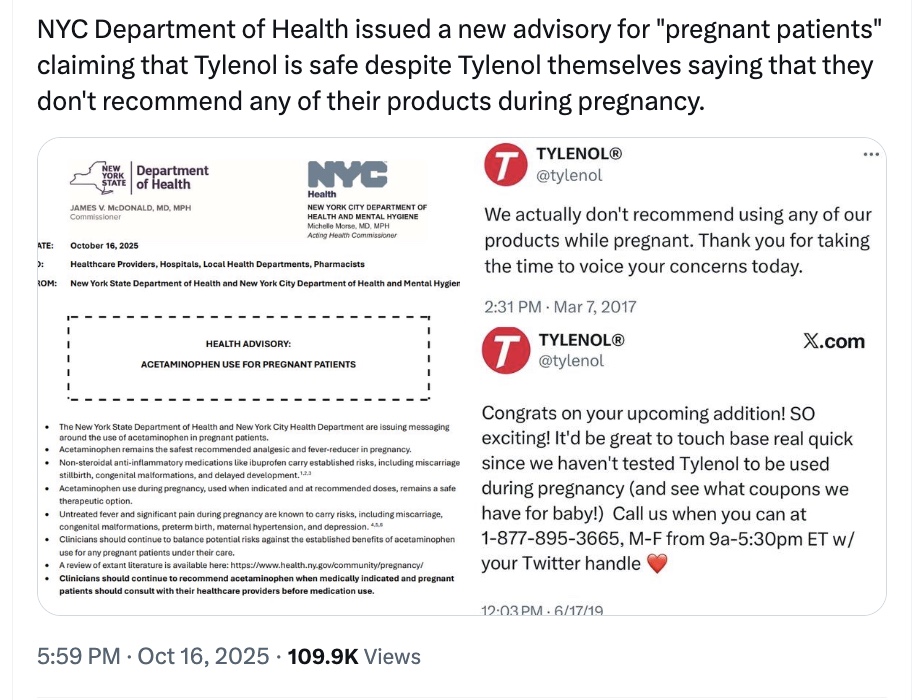
Kenvue’s response to ICAN’s petition states, “For over a decade, we have continuously evaluated the science on acetaminophen use in pregnancy and neurodevelopmental disorders, including autism—also known as autism spectrum disorder (“ASD”)—and attention-deficit/hyperactivity disorder (“ADHD”), and have found no causal association.”
Causality is a higher bar to prove, and it is not necessary for the FDA to require a product label. Kenvue states it has evaluated the science, but it does not say that acetaminophen use during pregnancy has been proven safe.
The legal statute – 21 CFR § 201.57(c)(6)(i) regarding FDA drug labeling states, “The labeling must be revised to include a warning about a clinically significant hazard as soon as there is reasonable evidence of a causal association with a drug; a causal relationship need not have been definitely established. A specific warning relating to a use not provided for under the “Indications and Usage” section may be required by FDA in accordance with sections 201(n) and 502(a) of the act if the drug is commonly prescribed for a disease or condition and such usage is associated with a clinically significant risk or hazard.”
The three studies presented by Commissioner Makary that conclude an association between acetaminophen use during pregnancy and neurological complications may be deemed “reasonable evidence” of a “clinically significant hazard.” Evidence is not the same as proof, which is typically the requirement for liability in the court of law.
Courts have upheld that regulatory standards err on the side of caution and are not proof of causation. In Valentine v. PPG Industries, Inc., the Judge concluded “[S]ubstances are regulated because of what they might do at given levels, not because of what they will do… The fact of regulation does not imply scientific certainty. It may suggest a decision to err on the side of safety as a matter of regulatory policy rather than the existence of scientific fact or knowledge… The mere fact that substances to which [plaintiff] was exposed may be listed as carcinogenic does not provide reliable evidence that they are capable of causing brain cancer, generally or specifically, in [plaintiff’s] case.”
Kenvue asserts that the language of the proposed consumer warning label “claims a causal connection” between acetaminophen use during pregnancy and neurological disorders like ASD and ADHD.
The petition by ICAN asks for a consumer-facing warning that states “If you are pregnant or breastfeeding, ask a health professional before use. Studies show that frequent use of this product during pregnancy may increase your child’s risk of neurodevelopmental disorders, including autism spectrum disorder and attention deficit/hyperactivity disorder. If you use this product during pregnancy to treat your pain and/or fever, use the lowest effective dose for the shortest possible time and at the lowest possible frequency.”
The proposed warning label does not state there is a causal connection, but states that “frequent use” of the product “may increase” the risk of neurodevelopmental disorders based upon conducted studies.
Kenvue alleges a potential conflict between ICAN and HHS Secretary Robert F. Kennedy Jr. based upon a New York Times article and the fact that ICAN submitted its petition on the same day of the Trump administration announcement.
Kenvue states that the Boston Birth and Nurses’ Health studies did not properly adjust for confounding factors. The company states the Prada (2025) study, known as the Mt. Sinai study, did not establish causation. The company did not provide a critique of the study design itself, but said three of the four authors have served as expert witnesses in acetaminophen litigation.
The Mt. Sinai study concluded “Our analysis demonstrated evidence consistent with an association between exposure to acetaminophen during pregnancy and offspring with NDDs, including ASD and ADHD, though observational limitations preclude definitive causation.” The authors added “as acetaminophen has become the recommended pain reliever for pregnant mothers, the rates of ADHD and ASD have increased > 20-fold over the past decades.”
The HighWire reported last month about Texas Attorney General Ken Paxton’s lawsuit against Kenvue and Johnson & Johnson for “willfully ignoring” the science while referencing 26 epidemiological studies that found an association between pre-natal acetaminophen exposure and ASD and ADHD. Paxton also alleges that Johnson & Johnson violated the Texas Uniform Fraudulent Transfer Act by fraudulently transferring Tylenol to Kenvue as a way to protect assets against future liabilities for harms caused by the product.


