CDC Updates Website: ‘Vaccines Do Not Cause Autism’ Is Not An Evidence-Backed Claim
Updated


The CDC website has now updated its page on vaccines and autism to state, “The claim ‘vaccines do not cause autism’ is not an evidence-based claim because studies have not ruled out the possibility that infant vaccines cause autism.” Previously, the country’s leading health authority has definitively claimed “vaccines do not cause autism.” The updated page states that the Data Quality Act “requires federal agencies to ensure the quality, objectivity, utility, and integrity of the information they disseminate to the public.”
The website still contains a header that reads “vaccines do not cause autism,” with an asterisk. A note near the bottom of the page states that the header remains on the website as part of an agreement with the chair of the U.S. Senate Health, Education, Labor, and Pensions Committee, which is Senator Bill Cassidy.
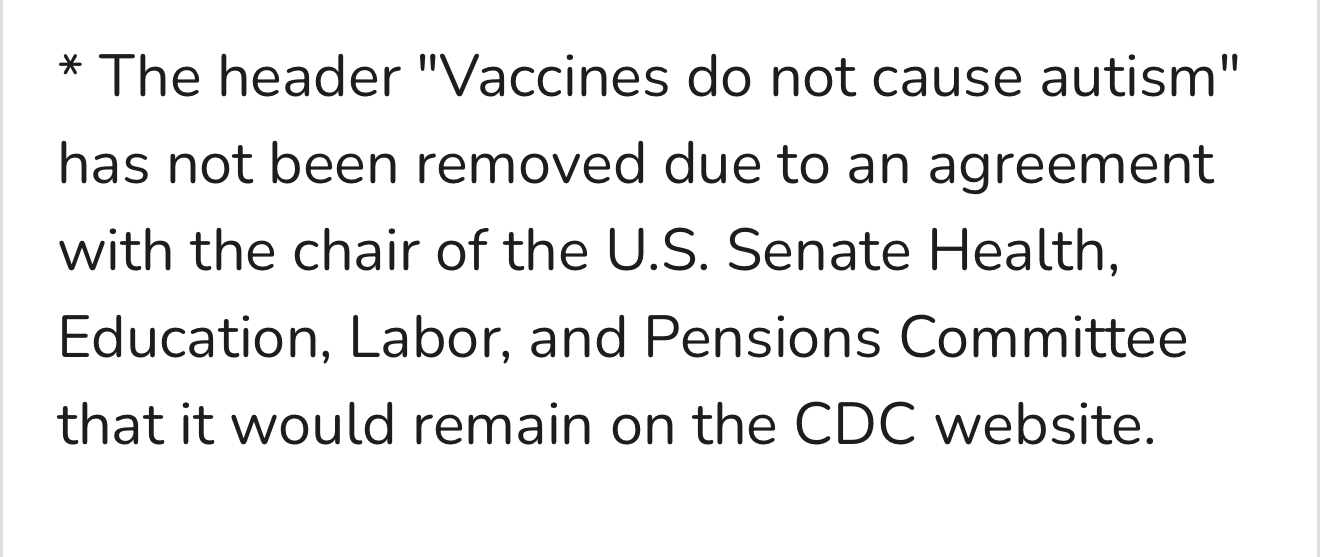
Reportedly, keeping the statement on the website was part of the agreement for Kennedy to receive a confirmatory vote from Senator Cassidy, although the website now explains that the claim is not evidence-based. Cassidy has not made a statement in response to the CDC website update.
The Informed Consent Action Network (ICAN) and attorney Aaron Siri, Esq., sued the CDC in 2020 seeking the studies that support the claim. Siri explained during a Congressional hearing that they were asking for the studies that prove that five specific vaccines don’t cause autism – specifically, DTaP (diphtheria, tetanus, and pertussis), Hepatitis B, Haemophilus influenzae (Hib), polio (IPV), and pneumococcal conjugate (PCV). “They gave us 20 studies – Not one of them has to do with those vaccines,” Siri said. “They’re all MMR or they’re all thimerosal. This notion that there’s a mountain of studies out there that show vaccines don’t cause autism is ridiculous.”
CNN reported this morning that the CDC has included “false claims” connecting autism to vaccines. The outlet also states that there is an “abundance of evidence that there’s no connection between autism and vaccines,” while stating “no environmental factor has been better studied as a potential cause of autism than vaccines.” The article links to an article claiming the theory has long been debunked. It links to the studies related to MMR, thimerosal, and autism, but has no specific studies looking into the five vaccines outlined by the CDC page update and the subject of the 2020 ICAN lawsuit against the CDC.
The CDC website update provides sources and counters the claims that a potential link between autism and vaccines has been “debunked.” The study most frequently cited as finding “no increased risk for neurodevelopmental disorders with early childhood exposure to aluminum-adsorbed vaccines” was mentioned in the CDC website update. The page states, “a detailed review of the supplementary tables shows some higher event rates of neurodevelopmental conditions with moderate aluminum exposure (Supplement Figure 11 — though a dose response was not evident) and a statistically significant 67% increased risk of Asperger’s syndrome per 1 mg increase in aluminum exposure among children born between 2007 and 2018 (Supplement Figure 4). Together, these findings warrant further investigation of aluminum exposures (high, low, and none) for a variety of childhood chronic diseases, including autism.
The CDC page also claims that studies supporting a link between vaccines and autism have been ignored by health authorities. The CNN report counters that those studies have been found to be fraudulent, poorly conducted, or biased. The CDC states, “Of note, the 2014 Agency for Health Research and Quality review also addressed the HepB vaccine and autism. One cross-sectional study met criteria for reliability; it found a threefold risk of parental report of autism among newborns receiving a HepB vaccine in the first month of life compared to those who did not receive this vaccine or did so after the first month.”
The CDC added that, in addition to the five previously mentioned vaccines, there are also no studies showing that rotavirus and influenza vaccines cause autism. These seven vaccines account for 20 doses that are recommended on the childhood vaccine schedule for all American children within the first year of life.
The CDC update also references a 2012 Institute of Medicine(IOM) review of the published MMR-autism studies at the time that found all but four of the studies had “serious methodological limitations.” The IOM gave them no weight. The CDC states, “The remaining four studies and a few similar studies published since also have all been criticized for serious methodological flaws. Furthermore, they are all retrospective epidemiological studies which cannot prove causation, fail to account for potential vulnerable subgroups, and fail to account for mechanistic and other evidence linking vaccines with autism.”
An ICAN document and “Vaccine Trial Pyramid Scheme” show that none of the routine childhood vaccinations were licensed based on a long-term placebo-controlled trial, which is considered the gold standard for scientific studies. When a vaccine is licensed, the standard of care says that it is unethical to conduct a study with an intert-placebo.
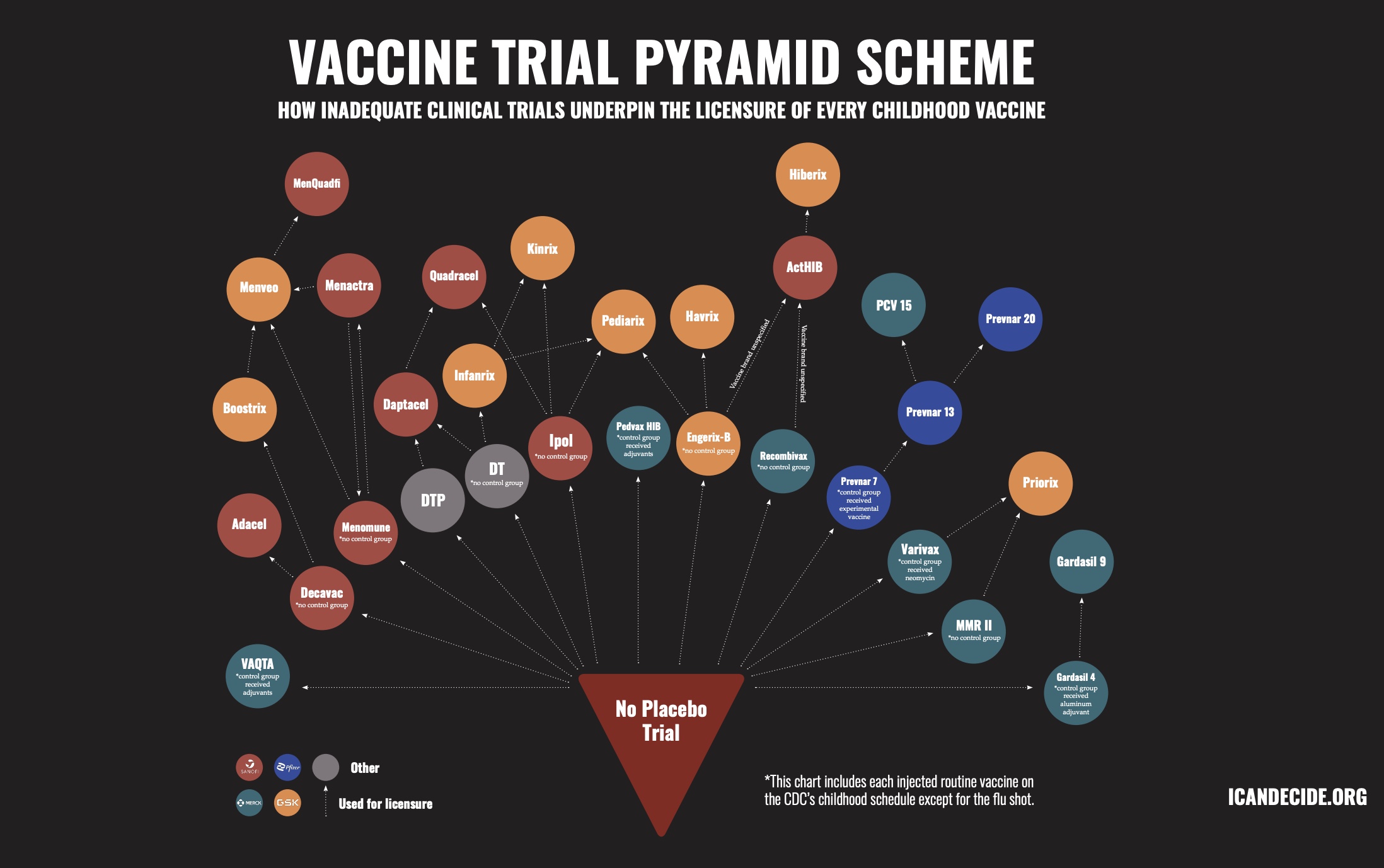
During an ICAN press conference in which the organization released recordings of Peter Marks, Siri made remarks about the difficulty in proving causation or conducting a study that is universally seen as a reliable scientific study.
“Generally, it’s the typical retort that we encounter all the time,” Siri said. “Post-licensure, the only thing you can do is retrospective epidemiological studies, and those can never prove causation. You have to look at the clinical trial. Ok, well, let’s look at the clinical trial. ‘No, the clinical trial can’t answer the question,’ you just heard Peter Marks say that. The clinical trial’s not good enough; the post-licensure can’t prove causation. How do you ever prove a vaccine causes an injury? This is the shell game they play.”


