Four Bad Options: What Trump Faces After the Iran War Sank the Midterms
Updated


The midterms defeats were stunning. Republicans saw their share of the vote decline in about 99 percent of counties, and they failed to capture any of the contests that had been widely rated as competitive going in. The party’s net loss of seven Senate seats already stands as one of the steepest midterm setbacks for the president’s party in the modern era. Democrats essentially ended the period of unified Republican government in a single election.
Why did this happen?
While FOX News and popular podcasters circled the wagons, making excuses and pointing fingers at each other for the midterm losses, Vice President JD Vance decided it was time to break from the narrative he was part of with a post-election X post.
Citing internal data analysts and pre-election pollsters, VP Vance stated: “The real reason we lost is obvious to almost everyone.”
Why have voters abandoned the [Republican] party and “What would cause them to come back on our team.” Vance wrote, “End the war.”
Even Don Jr. came out on his podcast and admitted, “The Iran war is largely what shifted voter sentiment and caused this wave.”
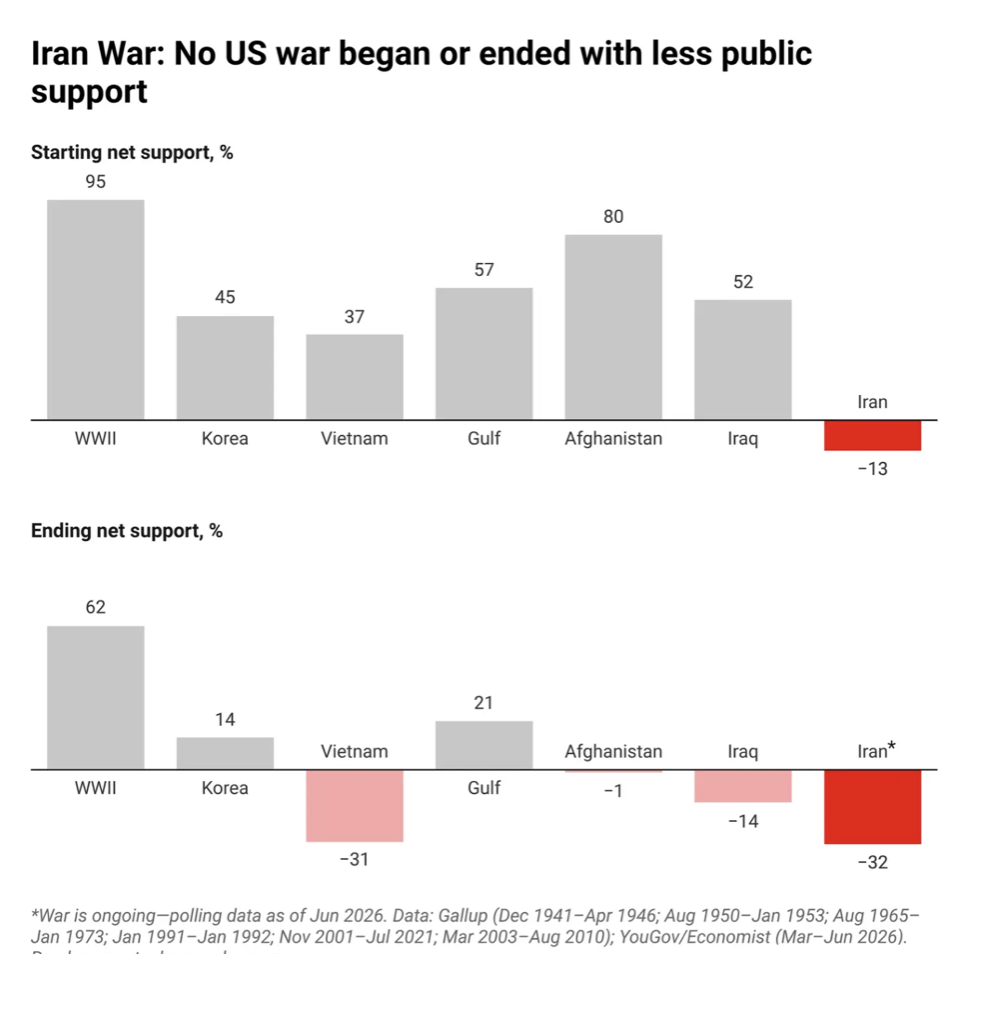
For anyone paying attention, a pair of June polls told the story. Results from an Economist/YouGov Poll found that the Iran war was the most unpopular military conflict in U.S. history.
On June 17th, the U.S. and President Trump entered into a Memorandum of Understanding (MOU) with Iran to end the war “rather than possibly going into a depression,” in his words.
ABC News wrote at the time the President “…was motivated to finalize the memorandum of understanding (MOU) with Iran to prevent “economic catastrophe” if the war was not resolved soon.”
In a recent analysis, Professor of Political Science at the University of Chicago John J. Mearsheimer stated about the MOU:
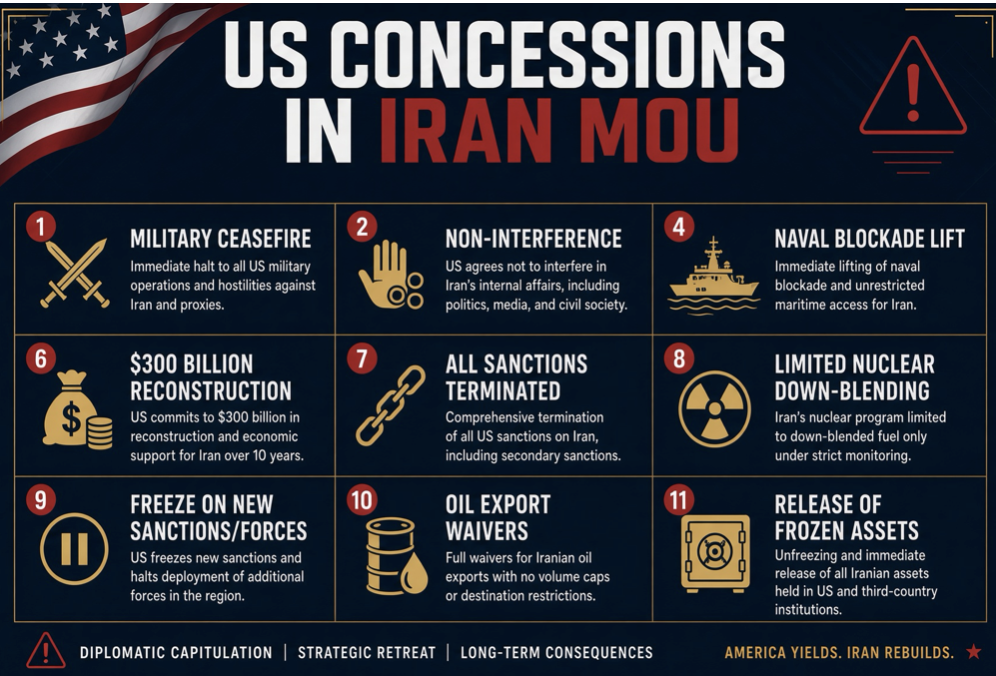
“…this was basically a surrender document. And when I say it’s a surrender document, what I’m saying is that that deal that President Trump agreed to in the memorandum of understanding was basically a victory for the Iranians. They laid out all of their principal goals, and these were goals that, if the United States accepted, made it very clear that we were, in effect, surrendering.”
Of the 14-point MOU text released by CNN, the image below summarizes some of the points which caused Mearsheimer to frame it as a ‘surrender document.’
At the time, an internal Fabrizio poll Trump shared on Truth Social showed 67% favored the deal between Iran and the U.S., although agreement didn’t hold after strikes continued.
The reality of the situation now is far less sober and confident. Trump now faces four options in Iran he has publicly toyed with:
A Short Bombing Campaign After the Midterm Elections: Modeled on the earlier 40-day campaign yet unlikely to succeed. If 40 days of bombing strikes didn’t end the conflict, what victory will a few days achieve? Additionally, the risks of massive Iranian retaliation, as they have threatened if stuck, on a litany of sensitive, reachable infrastructure targets from energy to water desalination plants on U.S. Middle East allies would create a humanitarian crisis.
Continuing Current Blockade and Economic Pressure: A 2007 study looked at 174 sanction campaigns waged worldwide between 1915 and 2000 and found they achieved their goals in only a third of all cases. Additionally, sanction-targeted states will often form new partnerships to offset lost trade, turning coercion into an accelerant for new global alliances. The ongoing sanctions in this case haven’t worked, as evidenced by the continued conflict. Finally, if the economic pressures begin to redline the Iranian economy, their ‘back against the wall’ posture may again lead to the above-described targeting of sensitive infrastructure.
Diplomacy: Favored by VP Vance and U.S. Special Envoy to the Middle East Steve Witkoff, the option would mean accepting a deal similar to the June 17 memorandum and was previously favored in polling by the American people.
A Limited Nuclear Strike: A “one-and-done” idea that is hard to execute, will not end the war, and would set dangerous precedents globally.
Apparently missing the war’s unpopular view domestically, as evidenced by the midterm results, Trump appears to be doubling down.
Two days after the midterms, on Thursday evening, while speaking to the press, he described the Iran war as “virtually an occupation” while teasing “I would rather not destroy the rest of the country if possible, but maybe I’ll have to. You’ll know soon enough.”