Appeals Court Questions Judge’s ACIP Block Advisers as CDC Walks Back Aggressive COVID Recommendations
Updated


Recently, U.S. Justice Department attorney Matthew Zorn argued during an appeals court hearing before the 1st US Circuit Court of Appeals in Boston that the March 2026 ruling of U.S. District Judge Brian E. Murphy in Massachusetts was preventing the Advisory Committee on Immunization Practices (ACIP) from meeting due to concerns that any new appointments Kennedy made to it could also be blocked.
Judge Murphy originally granted a preliminary injunction halting HHS Secretary Robert F. Kennedy Jr.’s overhaul of the childhood immunization schedule, freezing the newly appointed ACIP members, and staying votes and recommendations the committee made. that changes related to the ACIP and federal vaccine guidance.
ACIP has forfeited two regularly scheduled meetings, with a third next week also in question due to the court injunction.
The appeals court argument last week was the DOJ’s attempt to unfreeze ACIP so the committee could once again review vaccine safety and set immunization schedules.
Meanwhile, the CDC has recently revised its website to reflect a full-throttle COVID vaccine push on children and pregnant women. A highly questionable scientific move that would have surely been hotly contested or overturned if ACIP had stayed its course before the court’s intervention.
The AAP-led plaintiffs claimed that HHS Secretary Kennedy illegally reconstituted the CDC’s ACIP when he fired all 17 prior members.
Those prior members were responsible for near-unanimous rubber-stamping of every COVID shot for any age during the failed pandemic response. They also refused to honor informed consent and shared-clinical decision making.
The plaintiffs claimed that Kennedy’s move violated law because it was a departure from longstanding practices while his new members weren’t ‘fairly balanced.’
Reading between the lines, ‘fairly balanced’ means having conflicts of interest with the pharmaceutical industry.
For balance, there was little concern in 2024 when half the ACIP committee was replaced at once. The Informed Consent Action Network (ICAN) submitted FOIA requests seeking more information on these appointments and, when HHS failed to respond in accordance with the law, ICAN brought suit.
ICAN’s investigation found seven appointees had massive conflicts with Pfizer, Merck, AstraZeneca, GlaxoSmithKline, Janssen and others.
No court battle, no preliminary injunction just business as usual at that time.
Reuters writes regarding last week’s appeal:
“Some members of the three-judge appeals court panel on Tuesday raised concerns about how Murphy had crafted his order, which blocked 13 appointees from serving. Chief US Circuit Judge David Barron said it lacked any explanation for why blocking Kennedy’s appointees was legally authorized or justified. “It’s hard to know precisely what harm this relief was designed to address,” he said.
The narrative being sold that fighting for ‘science’ requires including a large percentage of experts having conflicts of interest with industry is indefensible.
A new study from the Cochrane Collaboration ended the conversation once and for all.
Researchers looked at 93 studies assessing the effects of pharmaceutical industry promotional interactions with prescribers.
To the surprise of no one, they concluded the following:
“Overall, we found that promotional interactions clinicians have with pharmaceutical companies are probably associated with harmful outcomes: less appropriate prescribing, greater quantity of medicines prescribed or provided, higher prescribing costs, and a greater likelihood of recommending hospital formulary additions of the company’s drugs.”
Read that again: “harmful outcomes.”
Dr Lisa Bero, a medical expert at the University of Colorado Anschutz and study author, said: “Overall, when doctors have more contact with drug company promotion, prescribing tends to become less appropriate, more frequent, and more expensive.”
Human nature argues these influences and conflicts become amplified when the doctors, scientists, and researchers take large sums of grant money from pharmaceutical companies and are investigators of their drugs in studies funded by the companies, like previous ACIP committee members embodied before Kennedy reconstitution.
The harmful outcomes become greater when those conflicted experts now make vaccine policy for the entire country of patients with the one pharmaceutical product that has liability protections.
The stakes couldn’t be higher for the public, regulatory leadership, and the DOJ to fight to remove or vastly dilute ACIP members with such conflicts.
Kennedy was installed into HHS because of his commitment to do just that. He acted, and the last option for pharma was to activate the courts. The misuse of justice in this case is clear despite the ‘we believe in science’ veil legacy media attempts to portray it as.
Finally, the CDC attempted to update its COVID-19 vaccine recommendation page to claim the following:
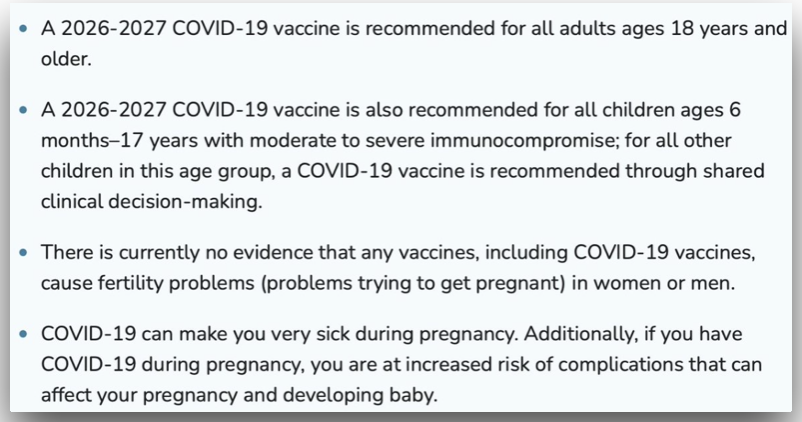
After massive public pushback, the agency has changed its page and now only recommends the shot to all adults and “children ages 6 months–17 years with moderate to severe immunocompromise.”