From AI Utopia to Outages: The AI Boom Is Collapsing While Cyber Attacks Ramp Up
Updated


The public was sold on the magic of artificial intelligence (AI). From humanity’s savior as a disease curer and job eliminator ushering us all into utopia, the technology’s lofty marketing sheen has now tarnished. A stark reality is setting in, causing the greater public to reevaluate our relationship to this generation’s glorified autocomplete tech.
Independent analysts and market observers have long flagged structural problems in the artificial intelligence investment boom. Political division has served to obscure a more focused reality and analysis of the true red flags. Republicans and the current administration largely took a ‘petal to the metal’ approach with AI and its data center buildout. More is better as long as we don’t ‘lose’ to China. A metric and objective never once defined or quantified
In late October, mainstream news signaled the AI bubble had crashed in China. The meltdown tanked China’s AI and semiconductor stock index leaders “by 40% in less than four months and vaporizing some $480 billion in market value,” wrote Reuters at the time.
Former BlackRock portfolio manager and Founder of Phinance Technologies Edward Dowd was the first to call America’s AI bubble burst with this X post in early November.
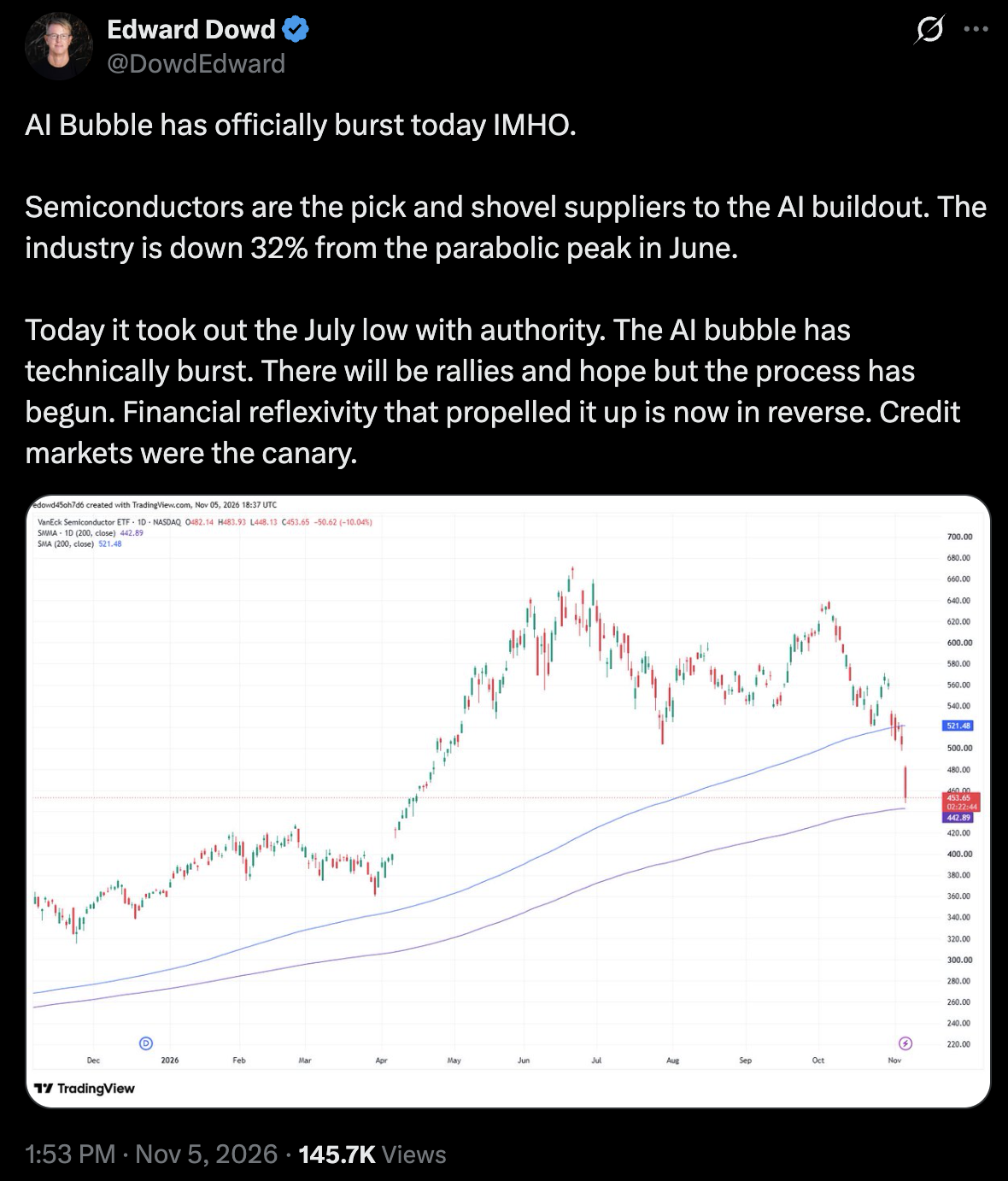
Dowd’s prediction is that the unwind will resemble the multi-year grind of the dot-com era rather than a single crash. Artificially inflated global demand for AI tech and its build-out masked the absence and greater realization of any real sustainable end-user economics.
In other words, it was never clear or proven that the business model could make money despite uneven investment on a generational scale that Goldman Sachs analysts estimated at $7.6 trillion through 2031.
What AI is proving to be useful for is the ongoing, high-profile cyberattacks on infrastructure we are currently living through. The largest institutional and organizational upheaval since the COVID pandemic or 9/11, with no easy answer or end in sight.
What started nearly two weeks ago with Microsoft outages and America’s great airline ground stoppage has cascaded into regular disruptions, with the official narrative carefully crafted and guarded to avoid panic.
Lost wires, an old router, or a routine system update provided early cover for the entire airline industry and legacy tech companies. These excuses, insulting and limited as they were to the public’s intelligence, have since fallen by the wayside.
Since last Thursday’s episode of The HighWire, where I covered the latest regarding the cyberattacks with Del, a continued volley of distributed security breaches appears unabated. Here’s the short list:
European Commission: AI-assisted cyber campaign disrupted internal personnel and HR systems for over 10 days. First detected in late October
U.S. Department of Agriculture (USDA): A Cybersecurity threat forced password resets across environments and took farm payment, loan, and related systems offline.
FBI National Crime Information Center (NCIC): A breach of the nationwide criminal justice database used for warrants, background checks, fugitives, and related records. Described as the second FBI-related incident in recent months.
Microsoft Entra Connect Health: An unauthorized access allowed reading of tenant metadata and administrator email addresses.
Bill Gates is warning about AI. Barack Obama is urging Democrats to make AI oversight central to their agenda. Bernie Sanders has introduced legislation carrying penalties of up to 20 years in prison. Then, a previously unknown Anthropic researcher went viral with an apocalyptic warning and was quickly featured across legacy media.
After the failures of the pandemic response, @JeffereyJaxen asks whether the public will once again trust experts demanding more government control in the name of averting catastrophe.
Why do powerful political figures suddenly want to throttle the development of artificial intelligence, and who benefits if they succeed?
Watch The Download every Monday at 5 PM PT/8 PM ET, right here on X or at https://t.co/Z12xa0sGYz!
— The HighWire (@HighWireTalk) September 15, 2026
With public warnings from Bill Gates, Barack Obama, and others with questionable motives and intentions in the months and weeks leading up to the AI-mediated cyberattacks, it appears that the public is once again being prepared to accept a predetermined outcome.
Problem…reaction…solution.
Growing cyberattack disruptions by unknown entities using advanced AI to breach even the best-protected systems will prompt a response. The predetermined global governance answers suggested in the past during tabletop exercises and media pre-positioning have largely been along the lines of further restricting our individual liberties.
Passports and intrusive digital identification to go online, central bank digital currency to protect bank accounts and retirements, unelected bureaucrats to govern the buildout and usage of a highly restricted artificial intelligence have been floated.
Writing in the midst of a long ‘Cybervember’ of outages, attacks, and official denials, there’s a feeling in the air that we are all just waiting for an invisible hammer to drop in some unknown way.