Will MAHA Plug In to Data Center Pushback?
Updated


The Make America Healthy Again movement and its figurehead, HHS Secretary Robert F. Kennedy Jr., have a full plate. The historical changes his administration has made have also been met with several speed bumps, to put things lightly. While the push-pull dynamic plays out, some causes wait on the sidelines to be activated.
What appears to be one of the lowest-hanging fruit is the growing American pushback against hyperscale data centers. Below is a map of major AI data centers in the U.S. that are either operational or under construction, overlaid with locations where community members have emailed in concerns to a tracking initiative by famed environmental advocate Erin Brockovich.
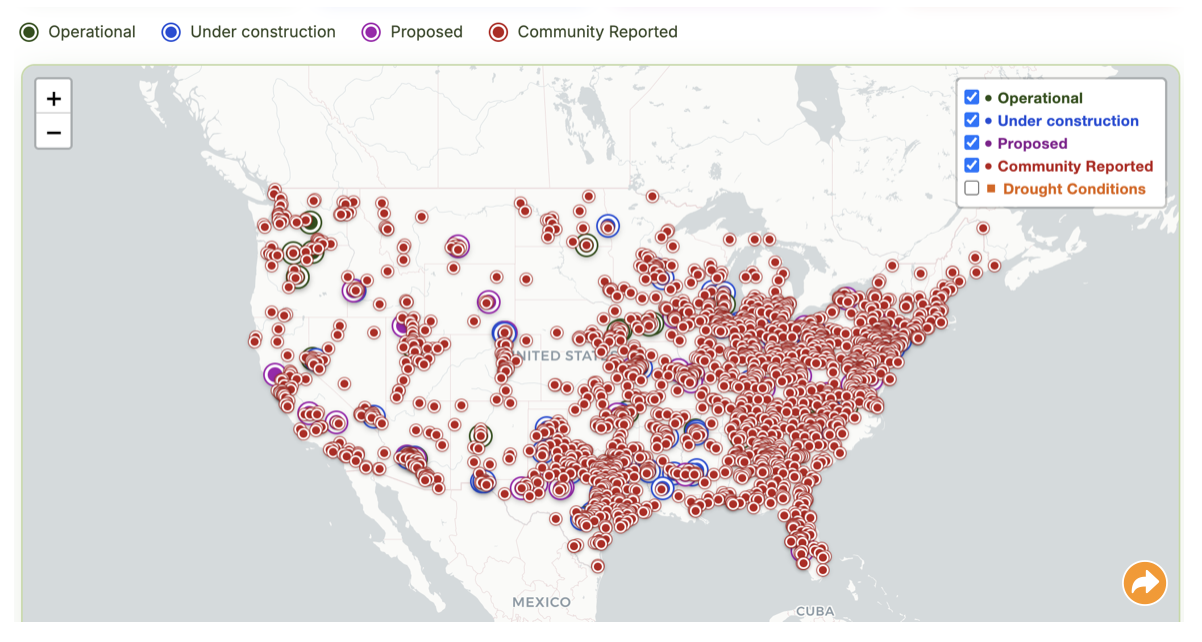
With over a year of archived videos and nearly 2 million views, MAHA Action’s YouTube page has only one 27-second video talking about data centers from Kennedy himself. Meanwhile, their X page similarly only mentions it once from the same reposted clip from their YouTube channel. Kennedy’s stated concern in the video is as follows:
“I think our priority at this point has to be food production and preserving farmland. And we’re seeing threats from data centers and also some of the government subsidies programs that are distorting the marketplace and making it difficult for people, for farmers, to actually farm their land by giving incentives to developers and to energy developers to take over that land and take it out of production.”
Far from a knock on the moment, Kennedy or anyone comprising it as the monumental goals MAHA set forth in the initial May 2025 MAHA Report commissioned by President Trump has enough to keep several administrations busy, let alone the current one.
Data center challenges sit in a completely different policy lane from MAHA. The Trump administration has supported AI and data center growth while working to expand power generation capacity (including nuclear options) to meet demand. On Thursday, President Trump said regarding data centers and energy/grid expansion:
“You have to convince your community how great these things…you can’t fight it. You have to go with it.”
MAHA remains focused on diet, chemicals, lifestyle, and vaccine safety and compensation reform, wireless radiation from consumer devices, and overmedicalization, to name just a few.
The main issues with U.S. data centers (especially hyperscale ones powering AI and cloud computing) are:
Energy consumption and grid strain: They accounted for about 4% of US electricity use in 2024, with projections indicating demand could more than double by 2030 (potentially reaching 6.7–12% of total US electricity). This strains regional grids (e.g., Virginia, the PJM region), contributes to higher electricity prices for residents, and poses reliability risks.
Water usage: Billions of gallons annually for cooling (especially evaporative systems), leading to local shortages and conflicts in some areas (e.g., impacts on wells or municipal supplies in Georgia and Arizona).
Local community impacts: Higher electricity bills; noise/vibration in some cases; land use, as Kennedy highlighted; and potential air/water quality effects if power comes from fossil-fuel engines rather than plugging into the grid.
Politics isn’t static, and voting blocks come and go. The current landscape sees several politicians, adversarial and indeed antithetical to the MAHA movement, stepping in to lead the critical mass of public resistance and community opposition to data centers.
Sen. Bernie Sanders is one of the most prominent voices. He was among the first in Congress to call for a national pause in late 2025 and co-introduced the Artificial Intelligence (AI) Data Center Moratorium Act four months ago. Governors Kathy Hochul (D-NY), Gov. J.B. Pritzker (D-IL) and Abigail Spanberger (D-VA) have all directed legislation to stifle data center advancement in their respective states. Hochul has taken the strongest action by imposing the nation’s first statewide moratorium on new hyperscale data centers via executive order.
The four names listed above have all battled Kennedy on his MAHA agenda implementation, with especially strong resistance to any and all vaccine-related initiatives.
The MAHA coalition has already begun to show power in midterm elections with the recent win of its first favored candidate, Iowa’s Republican nominee for governor, Zack Lahn.
Meanwhile, Big Tech is gearing up with heavy investment for the incoming social and political fight. Anthropic announced a $50 billion investment to build custom data centers in states like Texas and New York while recently doubling midterm spending to $40 million to push AI regulation.
In Virginia, the world’s largest data center market, an independent health study shows increased premature death and billions in health-related damages – an easy plug-in for MAHA.
Tangentially, the logical progression from the data center pushback appears to be opposition to Flock cameras and general mass surveillance. Flock opposition remains largely grassroots and local, with privacy groups emphasizing warrantless tracking of movements, data sharing, retention, and potential for abuse; however, positions can evolve quickly in a political environment careening towards an election cycle. The logical connection here would be the pandemic era’s digital vaccine passports used to track and limit life and liberty. A system that is still alive, as the World Health Organization boasted in 2023 that it would take up the European Union’s digital COVID-19 vaccine passport framework as part of a new global network of digital health certificates.