Regenerative Agriculture Gets The Trump Executive Order Treatment…But Is It Enough?
Updated


Many who understand the cumulative harms of compounding crop chemical exposure in our food supply point to (organic) regenerative agriculture as a better way forward.
A new Executive Order by President Trump looks to advance the practice of regenerative agriculture in America by acknowledging:
“These practices strengthen soil health, lower input costs, improve chemical efficiency to reduce overall use, improve farm profitability, maintain yields, increase market value, expand access to new markets, and strengthen rural economies. My Administration is committed to further actions that support farmers and ranchers as they seek to adopt these practices.”
The order goes further direct the following actions:
“The Secretary of HHS, in consultation with the USDA Office of Pest Management Policy and EPA Office of Pesticide Programs, shall issue a grand prize challenge from the National Institutes of Health for researchers to identify creative solutions for evaluating the exposure, diagnosis, and treatments of cumulative chemical exposures on individual health.”
To solve the mystery, “cumulative chemical exposures on individual health” in most, if not all, cases will trend towards harmful to human health. Meanwhile, “creative solutions for evaluating the exposure and diagnosis” of cumulative crop chemical exposure are of course always welcomed and needed for a society to evolve. However, the science is already there to show harmful impacts to human health on several of the most widely used crop chemicals in America and it’s not been followed. In fact, this administration just tipped the scales in the Monsanto v Durnell Supreme Court case in favor of continuing outdated, foreign crop chemicals moving towards what amounts to liability protection.
The elephants in the room are these very crop chemicals being increasingly used on American food and protected by consecutive administrations – the anthesis of organic regenerative agriculture.
Trump’s new order states:
“The Secretary of HHS shall, through the Advanced Research Projects Agency for Health, also prioritize research to identify new, innovative, and cost-effective technologies that reduce reliance on conventional chemical crop protection tools in order to reduce risks to human health.”
There it is…an admission! Conventional crop chemicals are a risk to human health.
More on that in a moment.
Here are three questions that need to be asked of this new Executive Order:
-Does the Executive Order help reduce the use or reliance on conventional crop chemicals?
Yes — via support for regenerative practices (which the order states can reduce overall chemical use) and research into technologies that reduce reliance on conventional (chemical) tools.
-Does the Executive Order specifically fund alternatives? Partially — through maximizing the regenerative pilot program and directing research/registration priorities, but not through new, targeted funding for non-chemical alternatives.
-Does the Executive Order eliminate public exposure to dangerous crop chemicals? No — there is zero language about phasing out, banning, or eliminating pesticides/crop chemicals or public exposure to them.
Trump’s new EO builds on USDA’s December announcement of a $700 million Regenerative Pilot Program to help American farmers adopt practices that improve soil health, enhance water quality, and boost long-term productivity in a bid to strengthen America’s food supply.
The Natural Resources Conservation Service (NRCS). NRCS is the office administering the Regenerative Agriculture Initiative. Only one problem, NRCS lost about 2,400 staff members, or 21% of staff nationwide, since late 2024.
American farmer Joel Salatin and his Polyface Farm are most universally recognized as modern pioneers of regenerative agriculture.
Meanwhile, the documentary trilogy: Kiss the Ground, Common Ground, and Groundswell have instilled the idea, philosophy and advantages of mainlining the use of regenerative agriculture into our lives.

Yet at the bureaucratic level there appears to still be a disconnect as Big Ag chemical players seem to be getting priority treatment in the administration despite giving regenerative agriculture a place at the table.
Here’s the real kicker for this, and future, administrations in one simple corporate media poll from Politico:
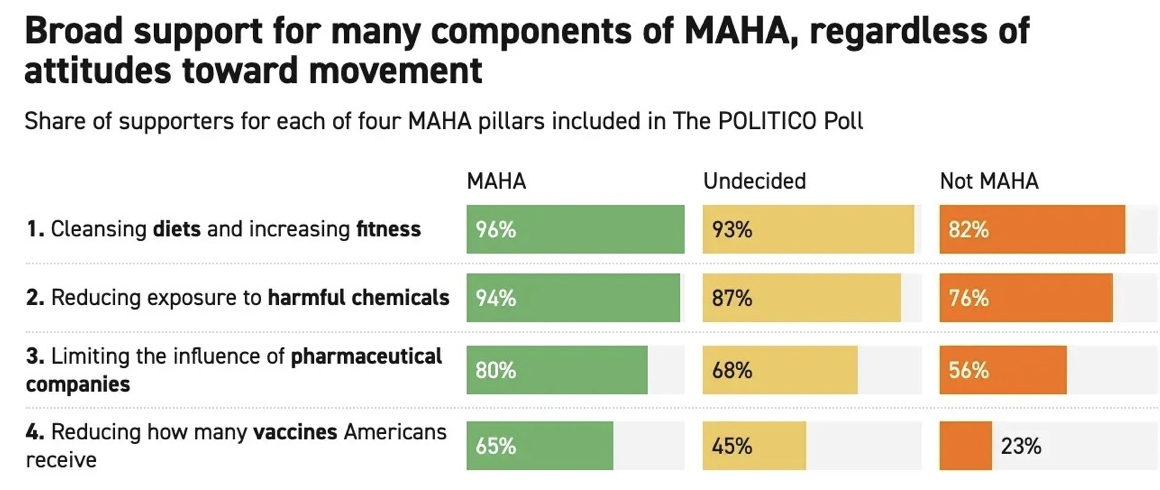
Simple takeaway: 76%-94% regardless of MAHA affiliation want reduction of exposure to ‘harmful chemicals’ (presumably including glyphosate/crop chemicals).
That is not what the current The Environment Protection Agency (EPA) is doing.
An new Environmental Working Group (EWG) press release tells shows the EPA has been on a chemical tear. In under two years, the conflicted agency has green-lit five PFAS pesticides.
“There was no warning to the farmworkers who will handle these chemicals or the families who will eat the food they’re sprayed on. The EPA published the fast-tracked approvals in the Federal Register in recent days. The hazardous new herbicides – trifludimoxazin, diflufenican and epyrifenacil – can now be sprayed directly on major food crops, including wheat and citrus.”
EWG continues:
“Despite the EPA’s internal data linking these chemicals to animal tumors and persistent water contamination, it quietly posted the approvals without informing the press or the public.”
To note, these newly minted forever chemical herbicides aren’t meant to replace glyphosate, they are meant to be used alongside it for the new class of glyphosate-resistant crops.
Like antibiotic resistance and continuous COVID boosters, modern solutions to living problems may not be solved by corporate chemical and pharmaceutical fixes when looking at the bigger picture.
The MAHA movement, arguably the most persistent, resilient political and social force moving into the 2028 elections, wants action and results. Those heading regulatory agencies have little wiggle room to play both sides of the fence as much of America is fed up with harmful chemical exposures no matter how the PR spin or political talking point attempts to justify it.