Scientists Discover Common Bacteria Cures 100% of Colon Cancer in Experiment
Updated


With ‘new’ American cancer numbers released this week, what many feared as an increase during the pandemic years appears to be a reality.
As for possible solutions from unlikely places, the list is varied, from DMSO to repurposed drugs like Ivermectin.
Bacteria are also being explored as cancer therapeutic agents due to their unique ability to naturally seek out, colonize tumors, and stimulate immunity.
Most preclinical and clinical studies have focused on genetically engineered strains, raising concerns about biosafety, regulatory burden, and translational feasibility. However, researchers from Japan’s Advanced Institute of Science and Technology (JAIST) have been thinking outside the box.
Several studies coming out of JAIST and its researchers are showing massive promise.

Associate Professor Eijiro Miyako at the Japan Advanced Institute of Science and Technology in Hokuriku
Professor Miyako’s specialty is bioengineering, and he’s been researching bacteria with anti-cancer properties for nearly 8 years, publishing several groundbreaking papers.
It all started with a theory to change the failed norm of clinically accepted cancer ‘therapies’.
Scientists are racing to end the barbaric status quo of giving systemic chemo ‘therapy’ during one’s cancer challenge, effectively poisoning the body and down-regulating the immune system. The idea of precision therapy vehicles to deliver therapeutics directly to the cancer/tumor is a major, ongoing area of research.
Unlike normal cells that use oxygen to efficiently break down glucose, cancer cells prefer a less efficient fermentation pathway (anaerobic/without oxygen), regardless of oxygen availability, which is called the Warburg Effect.
The experiment was simple: inject a cultured anaerobic bacteria into the body of a mouse with a tumor.
The idea was that the bacteria’s anaerobic affinity would exhibit tumor-homing capabilities, making it a natural candidate for a ‘microbiome-based’ cancer drug delivery system.
What happened next shocked the researchers. The bacteria not only magnetically attracted to the tumor’s oxygen-starved environment, it entered the tumor and began to shrink it without any adverse, toxic effects.
Professor Miyako and his team took the research further in 2024 to first test the anaerobic bacteria Cutibacterium acnes (C. acnes) against popular cancer therapies using a ‘Colon-26’ carcinoma syngeneic tumor model that encapsulates key features of human colorectal cancer.
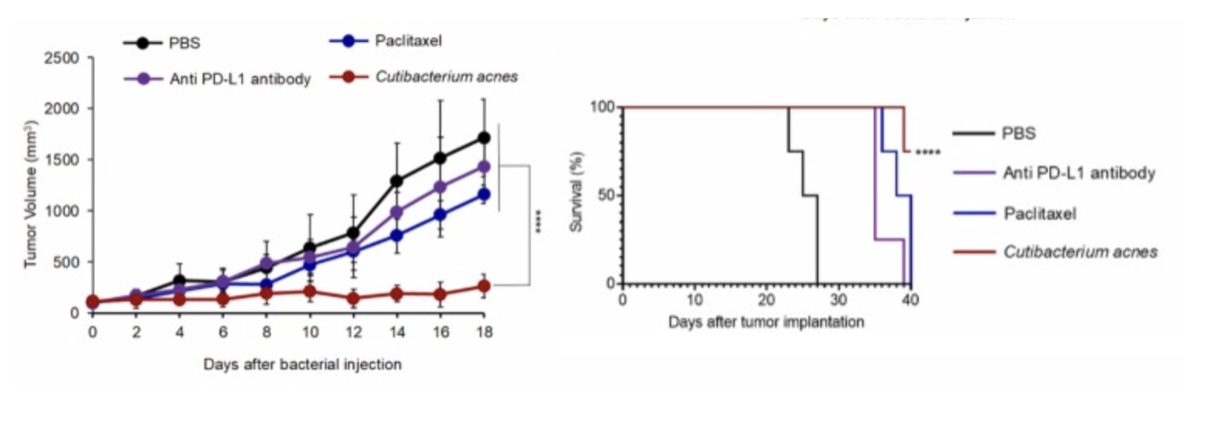
The red line on the first graph (left) above shows the work of the C. acnes in a game-changing moment. The bacteria was able to arrest the tumor progression, which became more impressive when compared against a placebo (PBS/black line), best-in-class immunotherapy with broad clinical adoption (Anti PD-L1 antibody/purple line), and standard chemotherapy (Paclitaxel/blue line).
The second graph (right) shows the survival rate of the same therapies with C. acnes again dominating the field.
Professor Miyako and co-authors conclude the following mechanism in their paper:
“The anaerobic nature of this bacterium C. acnes enabled it to effectively colonize inside the tumor and produce a few proinflammatory secretions to attract the immune system toward it by infiltrating immune cells into the tumor that could destroy the cancer cells, in addition to its innate ability to produce enzymes that dissolve the surrounding tissue.”
The authors further noted,
“…two of the mice in this group showed approximately 75% tumor reduction after 12 days of treatment.”
Building on the success of their 2024 study, Miyako and JAIST researchers turned their sights on other bacterial reservoirs of promise. This time, from the gut microbiota of amphibians and reptiles.
Their systematic evaluation in mice of nine bacterial strains against the human colorectal cancer model found eight that displayed significant antitumor effects following a single intravenous administration, highlighting the therapeutic richness of these unexplored microbial communities.
However, it was Ewingella americana (E. americana) that stood out among the pack.
As in the earlier study of C. acnes, E. americana also demonstrated a dual-action mechanism: direct tumor cell killing and activation of a strong host immune attack profile.
The authors importantly noted:
“E. americana demonstrated exceptional biocompatibility with no evidence of systemic toxicity or adverse effects on major organ systems, thereby establishing its promise in terms of both efficacy and safety.”
A stunning, unaccounted for benefit was further found as the authors report:
“Tumor rechallenge experiments demonstrated complete tumor rejection in all E. americana-cured mice (0/10 developed tumors) versus uniform tumor growth in naïve controls (10/10), providing evidence of durable antitumor immunity with immunological memory persisting beyond 60 days.”
The immune system remembered, fought, and completely rejected the ‘rechallenge’ introduction of the tumor cell material.
When weighted against the popular Anti-PD-L1 immune therapy and, this time, Liposomal doxorubicin (DOX) chemotherapy (FDA-approved nanoformulation), considered a state-of-the-art drug-delivery technology, the results were again impressive.
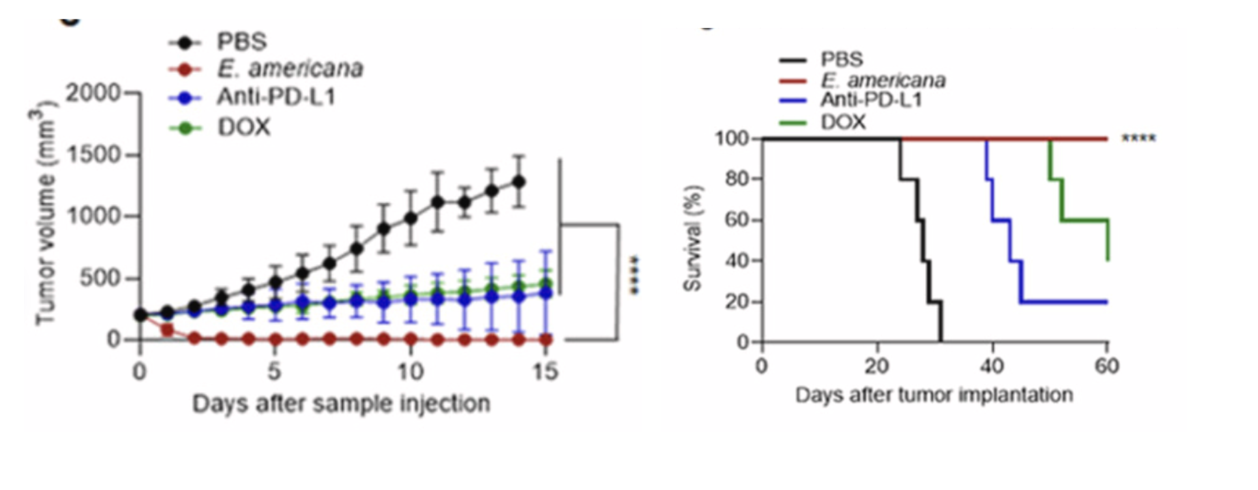
No tumor growth in the E. americana-injected mice (left graph, red line) and 100% survival rate (right graph, red line). Again, no toxicity or adverse effects on major organ systems.
In an interview with Professor Miyako from 2023, the report claims that JAIST plans to conduct additional trials on larger animals such as pigs, with the goal of achieving clinical use within the next 5 to 10 years (which puts it as early as 2028).
MY REPORT FROM THE HIGHWIRE ON THIS STUDY
WHAT WILL MAHA’S NEXT STEP BE TO ADDRESS CANCER?
At this point, there are several burning questions that need urgent answers:
-Will the MAHA-minded federal architecture, already shown to be aggressive in fast-tracking controversial therapies that show promise (most recently psychedelics plant-based medicines for mental health), be brave enough to disrupt the cancer status quo and accelerate, fund, and/or approve alternative cancer therapies?
-Will MAHA leaders, already turning down the volume on the COVID vaccine conversation, be bold enough (and allowed) to pull the shots from the market after these most recent cancer statistics?
-Will FDA, NIH or CDC allow official science to be published proving the cancer-causing mechanisms and increases from the Covid shot already laid out by other researchers around the world?
The ‘new’ 2023 cancer statistics still provide a 3-year lag to the reality we currently live in. The missing stats are pressing as they chronicle the extent of cancers from the mandated, experimental gene therapy injections given to most of the developed world.
The lost 3 years will tell the true story, just as the glimpse we have just been allowed into 2023 has shown.